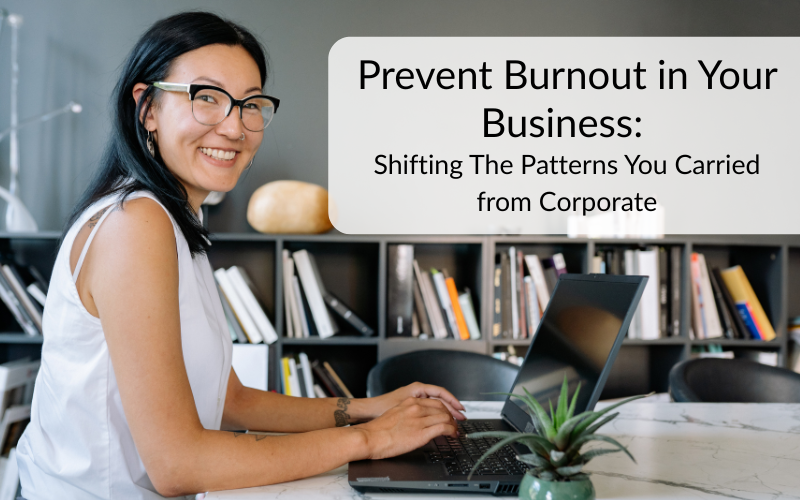
You made the leap. You left the corporate job that was sucking your soul, ready for freedom. You started your own business, thinking, “I’m finally in control. I’m finally free.”
And somehow, you’re here again. Exhausted.
Maybe it’s been a few months, maybe a year. But you’re noticing the same patterns creeping in. The stress, the overwhelm, the feeling that you’re doing too much and it’s never enough. On top of that, you’re judging yourself. You thought leaving the corporate grind would fix it, so you wonder: “What’s wrong with me? I chose this. Why do I feel like I’m back in the same trap?”
If this is where you are, I want you to know three things:
- Nothing is wrong with you.
- You didn’t make a mistake.
- It CAN get better.
Over the past decade working with women entrepreneurs, I’ve seen this again and again. The reason isn’t that you’re failing at entrepreneurship; it’s that you changed your circumstances, but you didn’t change the patterns your subconscious developed to survive those circumstances. And those patterns are no longer serving you.
Here are the burnout patterns that follow you and how they’re draining you:
- Lack of Control: You’re focused on outcomes you can’t control (sales, market shifts, other people’s opinions) or feel like life is happening to you.
- Unclear Job Expectations: You traded a boss with vague instructions for a business with vague goals. Instead of “be more of a leader,” you have “grow the business”—a subjective demand with no clear direction but a massive emotional load.
- The Perfectionism Loop: You left a critical boss, only to become your own harshest critic. You’re bullying yourself with perfectionism, policing every mistake (and potential mistake) with the same dread of failure you used to feel.
- Extremes of Activity: You’re swinging between chaos (launching, putting out fires) and monotony (repetitive chores, doing it all alone), both requiring a constant, unsustainable drain of energy.
- Lack of Social Support: You lost the water-cooler venting and the team dynamic. Now you carry the mental load alone, missing the natural stress relief that comes from human connection.
You might hear suggestions like “just breathe,” “get some exercise,” or “find a hobby.” These are vital for your nervous system, and I absolutely encourage you to integrate them. But without addressing the underlying patterns, they are just bandaids on a leaky boat. They’ll help you stay afloat for a moment, but they won’t fix the hull.
To build true sustainability, we need to stop treating the symptoms and start leading yourself differently. Here is how to move from understanding where you’re stuck to stepping out of it.
Step 1: You Are NOT Lazy; But You May Be Misaligned
The Pattern: You tell yourself you’re lazy, unmotivated, or stuck, but the real issue is that the tasks you’re pushing yourself to do are externally motivated expectations that don’t align with who you are or how you want to experience life, otherwise known as “shoulds.” Whether you’re an entrepreneur, a parent, or a professional, you’re running on a script from a past role or a societal playbook that doesn’t fit, leading to energy depletion, cynicism, and a feeling that life is happening to you. You left one environment (like corporate) to escape burnout, but you brought the same demotivating, disconnected “bad boss” patterns with you.
To shift it, try this: First, stop labeling yourself as lazy. Recognize that “not doing” is often a signal from your body and mind that it needs rest or that the task itself is misaligned. Ask yourself: Is this action coming from my values, or is it a “should” I inherited? If it’s a should, pause. Reconnect with why you started this journey in the first place. Rest is not a reward; it’s a requirement for clarity.
Step 2: The Invisible Work of Worry and Control
The Pattern: You feel exhausted even when you haven’t “done” much physically. Decision making takes energy and you have a lot more micro decisions as an entrepreneur. However, you’re going to burn even more energy if you’re also trying to control outcomes, manage other people’s expectations, or worry about the future. Trying to steer things that are fundamentally outside your jurisdiction carries an additionally exhausing emotional load. This constant, subconscious energy expenditure drains you faster than any physical task.
To shift it, try this: Audit your control. Write down what you are worried about or trying to manage. Circle only the items that are actually within your direct influence. For everything else, practice the art of “softening.” Instead of tightening your grip, ask: What would happen if I let go of this specific outcome for 24 hours? Redirect that energy into what you can control: your boundaries, your response, and your self-talk.
Step 3: Becoming Your Own Best Boss
The Pattern: You are your own worst manager. You micromanage your days, bully yourself with perfectionism, and set unclear or impossible job expectations. You’ve replaced an external boss with an internal tyrant, replicating the very dynamics you tried to escape.
To shift it, try this: Intentionally create your work environment and culture – including your ideal boss. Grab your journal and consider the following:
- What are the characteristics of your ideal boss? How do they support you? What are reviews like? How often do they happen?
- What is your ideal work environment? What is in your work space? What are the communication/interactional dynamics? When and where are you most focused with each activity?
Step 4: Redefining “Enough” and Setting Boundaries
The Pattern: You’ve set unreasonable or undefined expectations for yourself, leading to a constant sense of falling short. Additionally, much of our corporate world is built on exploitation, so you likely learned to dehumanize yourself and to forget that you must be included in what gets care.
To shift it, try this: There are often deeper worth layers influencing this step but to start, consider your energy like a budget.
- What are your strengths? What responsibilities maximize them? What responsibilities drain your energy? What of those could you delegate?
- When do you rest? What do you do to re-charge & re-focus? What do you do to support your “company culture?”
Your Next Step
You are not broken. You are simply navigating a new landscape with an old map.
The patterns that once felt necessary are no longer serving you in the life you want to build. This isn’t just about preventing burnout but about creating the world we want to live in.
We’re in a time of change and you’re evolving to meet it. We need more compassionate and collaborative leaders to create a more sustainable way of living, working, and being.
Thank you for being one of them!
Final note: Many of these patterns are embedded in multiple areas of life and run deeper than this article can help you go. If you find yourself resonating with this but still feeling overwhelmed and stuck, reach out. This is what coaching can help with and I’m happy to talk with you.
Valerie Friedlander is an ICF-certified Leadership Coach for mission-led women and organizations. She helps clients cultivate the clarity, confidence, and cohesion to create sustainable success without burnout. Through Energy Leadership™, somatic coaching, and a systems-aware approach, Valerie supports clients in navigating transitions, reclaiming authenticity, and leading with greater impact and ease.
Learn about her offerings and listen to her podcast, Mindset Unlimited, at https://www.valeriefriedlander.com
Content provided by Women Belong member Valerie Friedlander


































 Chicago emPower Breakfast
 RESCHEDULED Book Club: Mary Magdalene Revealed - ZOOM
 The Mothership
 SFG: How to Make More Aligned Decisions in Life & Business
 Book Club: Mind-Body Connection Unlocked - ZOOM