
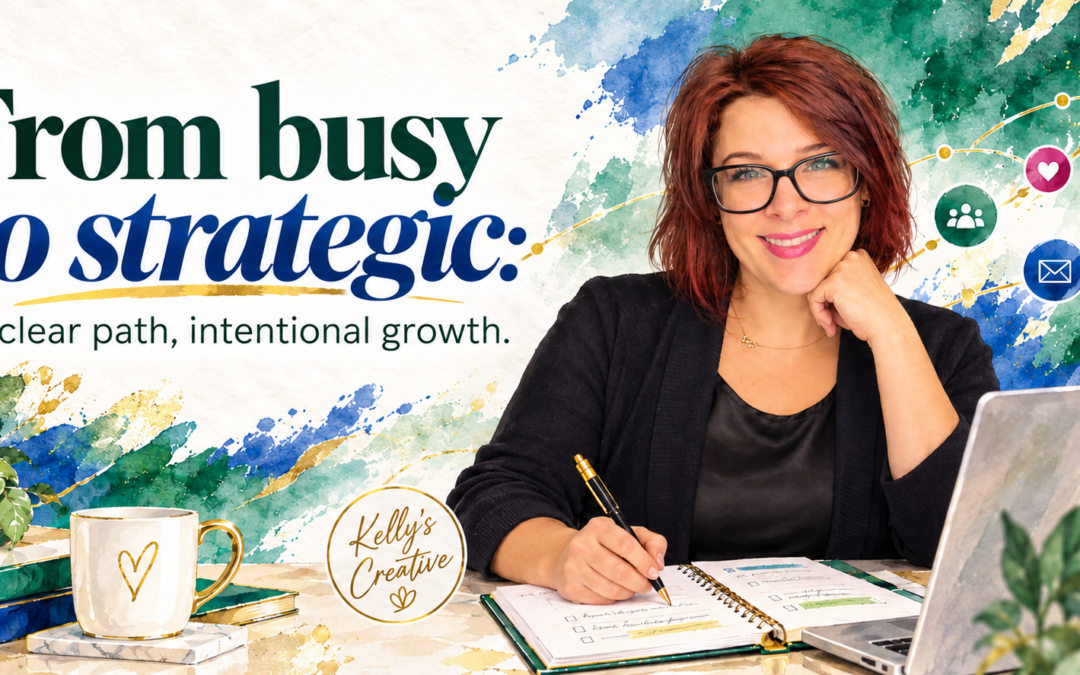
Most of us didn’t start a business to spend every day putting out fires. Still, in a typical week of answering emails, chasing invoices, handling “urgent” requests, and squeezing in a follow-up call, it’s easy to see how being busy can start to feel like progress.
They aren’t the same thing. Being busy is not the same as being strategic.
I recently led a session called Strategic Planning for Small Businesses & Entrepreneurs: Turning Day-to-Day Hustle Into a Deliberate Growth Plan. Below are the key ideas, and you can download the full slide deck free here to use as a reference for your own planning.
Why Bother With a Strategic Plan?
Most small businesses run reactively. We’re busy, but we aren’t always moving forward. A strategic plan separates chasing work from building a business. (If you’re starting from scratch, here are the steps to building a successful business strategy.)
So here’s the question I want you to sit with: Are you running your business, or is it running you?
5 Things a Strategic Plan Does for You
- Gives you direction and focus. You have a clear destination, so every decision moves you toward it instead of scattering your energy.
- Helps you allocate limited resources wisely. Your time, money, and people go to what actually drives growth, not just to what’s loudest.
- Turns goals into measurable, trackable action. Vague ambitions become milestones you can hit and measure.
- Prepares you for change and reduces risk. You see obstacles coming and have a Plan B instead of being blindsided.
- Aligns your team and your message. Everyone and every marketing touchpoint rows in the same direction, building a consistent brand.
Think Like a Strategist: 5 Questions to Ask Yourself
This is the reflective core of the whole session.
Grab a notebook and answer these honestly:
- Where do I want this business to be in 1, 3, and 5 years, and does today’s activity point there?
- Who exactly is my ideal customer, and what problem am I really solving for them?
- What makes me different from my competitors, and can my customers actually see that difference? (Here are some ways to stand out in a crowded market.)
- What’s working, what’s not, and how would I even know? (Do I measure it? Start with the social media metrics that matter.)
- If my best lead source disappeared tomorrow, what’s my plan? (Where am I over-reliant or exposed?)
Be Strategic About Getting Customers
With the right mindset, the next step is the growth engine: getting customers on purpose.
- Stop acquiring customers by accident. Figure out where your best customers actually come from, and double down there.
- Know your numbers. Know what a customer is worth compared with what it costs you to get one.
- Pick 2–3 channels and go deep rather than spreading yourself thin everywhere.
- Build repeatable systems, not one-off wins. Make acquisition a process you can predict and scale.
Leads Aren’t Customers Yet
Not every lead is ready to buy today.
Treat that in-between stage as a system:
- Capture → Nurture → Convert. Have a simple, deliberate follow-up path, a kind of “customer waiting room.” Automated email campaigns are one of the easiest ways to build it.
- Qualify your leads so you spend your energy on the people most likely to buy.
- Track where leads come from so you can invest in what works and cut what doesn’t.
Networking With Intention
Relationships are a strategic channel, not just coffee chats. (This one is close to my heart, and I know it’s close to yours too, Women Belong!)
- Network with a goal: referral partners, strategic alliances, and visibility, not just getting your name out there.
- Give before you get. Generosity and genuine relationships compound into referrals.
- Show up consistently where your ideal customers and referrers already gather, both in person and online.
- Turn conversations into a system. Follow up, stay in touch, and keep relationships warm.
The Digital Audit: Know Where You Stand
Here’s the central theme: you can’t be strategic about what you haven’t audited.
Start with an honest look at every place a customer meets your brand: your website, Google presence, social profiles, reviews, business listings, and email.
For each one, ask:
- Is it consistent?
- Is it current?
- Is it findable? (Today that includes AI search. Here’s SEO vs. AEO vs. GEO explained.)
- Does it convert?
Marketing isn’t a nice-to-have. It’s how your strategy becomes visible to customers.
The Customer Journey Happens In Person AND Online
Every customer goes through the same stages: Awareness → Consideration → Decision → Purchase → Loyalty. Today, the digital steps usually come first.
Map out every touchpoint. Can people find you on Google? (Here’s why local visibility matters.) Are they reading good reviews? Do they land on a clear website? Do they get a reply when they reach out? Is checking out or booking easy?
Every digital touchpoint is a moment of truth. Any gap or bad experience can cost you the sale before you ever meet the customer. Being strategic means designing that journey on purpose, not leaving it to chance.
Putting It All Together: Your Strategic Snapshot
- Direction: your plan
- Right customers: acquisition, leads and networking
- Visible & findable: marketing plus a digital audit
- Smooth journey: in person and digital
- Growth
“Strategy isn’t a one-time document. It’s a habit of asking better questions and reviewing regularly.”
Recommended Reading
- Traction by Gino Wickman
- They Ask, You Answer by Marcus Sheridan
- Zero Moment of Truth (ZMOT), Google’s research by Jim Lecinski
Your Next Step
Download the free Strategic Planning guide, then choose one of the five strategist questions and answer it this week. Just one. Next, look at a single touchpoint in your customer journey and ask whether it’s consistent, current, findable, and converting.
If you’d like a second set of eyes on your plan or your digital presence, I’d love to help. Book a Digital Clarity Session or a Growth Strategy Session, or just grab a virtual coffee date to connect.
I’m Kelly Austin, owner of Kelly’s Creative, a boutique marketing agency in Westmont, IL. I help small business owners swap hustle for a deliberate growth plan.
Content provided by Women Belong member Kelly Austin



































 You Got the Role, Now What?
 What If Your Body Isn’t the Problem? Rethinking Perimenopause, Hormones & Your Health
 The Mothership
 Connections - ZOOM Networking Event
 SFG: Tending the Sleeping Garden: Herbal Nourishment for Fall and Winter